

Two Electrical Cable Quotations Look Similar. Are You Actually Buying the Same Cable?

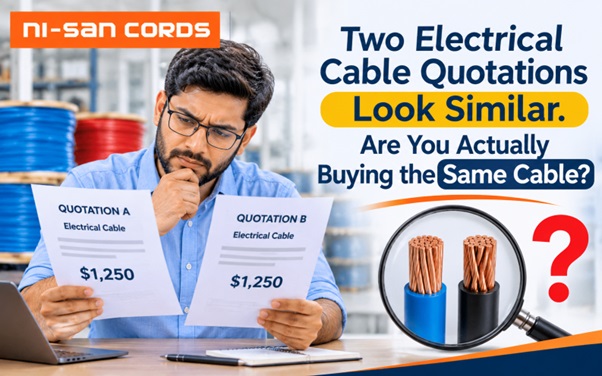
Two suppliers can quote a ‘1.5 sq mm three-core flexible cable’ and still mean different things. One offer might specify conductor class, insulation construction and test standard. The other might simply repeat the enquiry line. The search term ‘cable manufacturers India‘ covers suppliers with different constructions and test practices; comparing their quotations requires more than a price per metre. The details you do not ask about today tend to become the arguments you have after delivery.
Decode the description line by line
Start with conductor material and construction: copper or aluminium, solid or stranded, conductor class, nominal cross-sectional area and any specified resistance requirement. ‘Flexible’ does not mean every stranded construction bends equally. A nominal size is not a promise of identical strand count, diameter or resistance across unspecified designs.
Next identify insulation and sheath materials, rated voltage, core identification, thickness requirements, outer diameter limits, temperature range and intended installation. A cable used inside a dry appliance differs from one submerged in water or exposed to oil. If a quote says only ‘PVC cable’, the buyer still has significant unanswered questions.
Standards and certifications need precise wording
Ask which standard and edition apply to the quoted product, what tests are specified and whether the particular construction falls within any claimed certification scope. A manufacturer’s quality-management certification is not the same thing as product certification. In India, relevant BIS or IS references depend on cable type and application; do not assume one standard covers all cables sold by a company.
A credible quotation identifies the declared standard, conductor and insulation construction and the documentation available with each lot. If one supplier quotes a tested construction and another gives only a generic product name, the offers are not yet comparable.
Compare the delivered metre, not only the nominal metre
Clarify packing length, drum or coil size, permissible length tolerance, minimum dispatch quantity, freight basis, taxes, damage handling and whether partial reels are acceptable. A cheaper rate can become expensive if it produces extra joints, handling waste or line-side storage problems.
For high-volume OEM use, ask about conductor resistance and dimensional consistency, batch identification, change control and test certificates. A cable that performs well in one trial but varies across lots can create termination problems, scrap and unpredictable assembly time.
A simple comparison worksheet
A useful comparison sheet lists the application, standard and edition, conductor material and class, core count, insulation, sheath, rated voltage, dimensions, tests, certificates, packing length, lead time and pricing basis. Supplier catalogues—including those published by nisancords—are useful for identifying advertised ranges, not for establishing equivalence between two quotations. Where a quotation omits a field, record ‘not stated’ rather than filling it in from a general product description.
Then evaluate total cost. Include termination time, fit in glands or conduits, scrap, inspection burden, delivery risk and the consequences of failure. This is especially important when a cable is difficult to replace after installation.
Questions that expose a vague quotation
Is the heavier cable automatically better? No. Weight can come from a thicker sheath, a different conductor construction or simply a different design. Compare the requirements that matter to your installation.
What if one quote has a much lower rate per metre? Check conductor class and resistance, insulation and sheath specification, testing, packing length, freight and exclusions before assuming it is a saving.
Can two brands be treated as interchangeable? Not from their labels alone. Match the relevant standard, construction, dimensions and termination compatibility, then follow your own change-approval process.
Two suppliers can quote a ‘1.5 sq mm three-core flexible cable’ and still mean different things. One offer might specify conductor class, insulation construction and test standard. The other might simply repeat the enquiry line. The search term ‘cable manufacturers India‘ covers suppliers with different constructions and test practices; comparing their quotations requires more than…